
Missouri Death Records
Missouri death records are public documents held by the Bureau of Vital Records in Jefferson City and by local health departments in all 115 jurisdictions across the state. Death certificates from 1910 to the present can be searched through state and county offices. Records older than 50 years are free to view online at the Missouri State Archives. You can get copies by mail, in person, or through an online vendor. Whether you need a death certificate for legal matters, insurance claims, or family research, Missouri has several ways to search and request these records at both the state and local level.
Missouri Death Records Quick Facts
Where to Find Missouri Death Records
Missouri keeps death records at two main levels. The Missouri Bureau of Vital Records in Jefferson City holds death certificates from January 1, 1910 to the present. This is part of the Missouri Department of Health and Senior Services. The Bureau can issue certified copies to eligible people. It also has records for births, marriages, and divorces. The office is at 930 Wildwood Drive in Jefferson City and is open Monday through Friday from 9 AM to 3 PM for walk-in visits. You can call them at 573-751-6387 or email VitalRecordsInfo@health.mo.gov for help with your request.
County health departments are the other main source. Missouri has 115 Local Public Health Agencies spread across the state. These local offices keep death records from 1980 to the present. If you know where the death took place, the county health department in that area can often print a copy the same day you walk in. This is much faster than a mail request to the state. Most charge $14 for the first copy and $11 for each one after that.
The Missouri State Archives holds death certificates that are more than 50 years old. Under RSMo 193.225, these older records get moved to the Archives for public use. You can view digitized death certificates from 1910 to 1975 for free through the Missouri Death Certificate Database. The Archives is at 600 W. Main Street in Jefferson City. You can also reach them at 573-751-3280 or archref@sos.mo.gov.
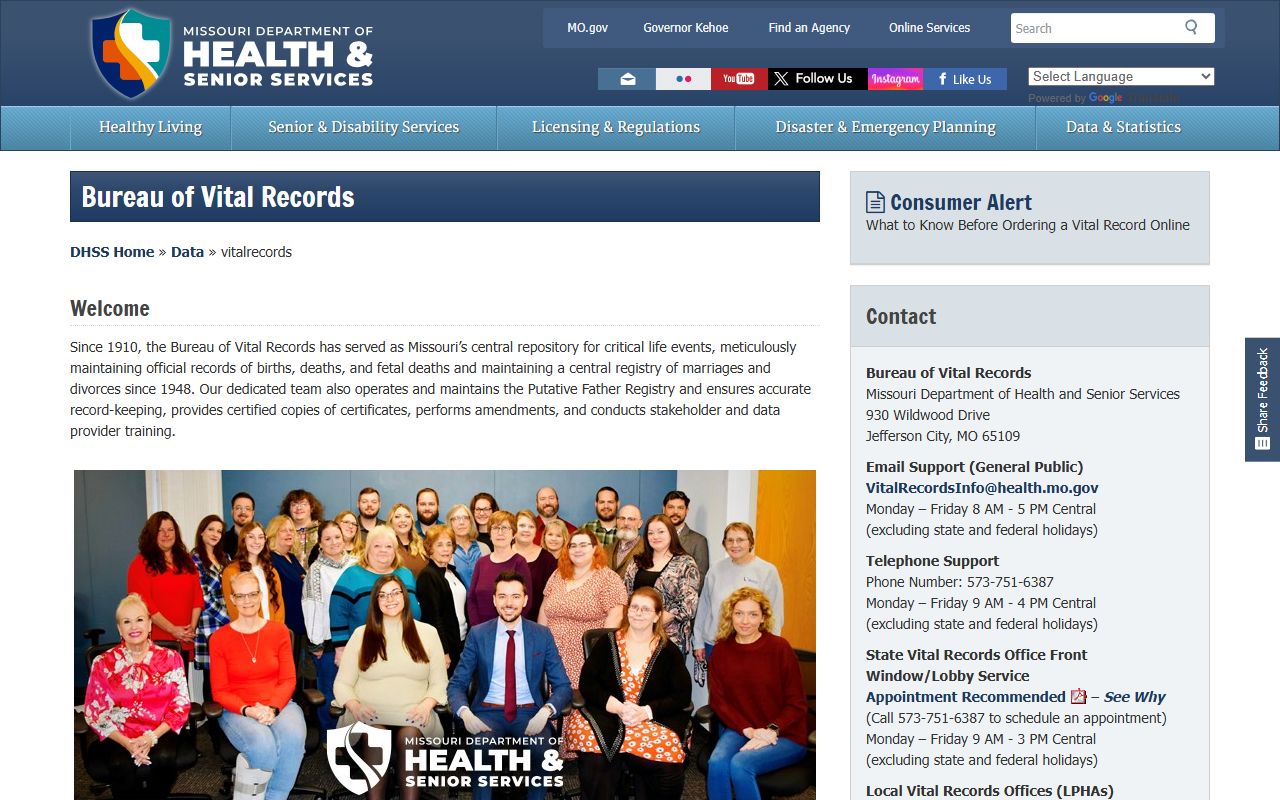
The Missouri Bureau of Vital Records homepage below shows how to start your search for death certificates at the state level.
Note: County health departments can print death certificates the same day for records from 1980 forward, while state mail requests take 4 to 8 weeks.
How to Get Missouri Death Certificates
There are three ways to get a death certificate in Missouri. Each method has a different cost and wait time. The right choice depends on how fast you need it and whether you can visit an office in person.
The fastest option is to go in person to your local county health department. Walk in with a photo ID like a driver's license, passport, or military ID. If you don't have a photo ID, bring two other forms of identification such as a utility bill and insurance card. The staff will look up the record and print it while you wait. Most visits take 10 to 30 minutes. You pay $14 for the first certified copy and $11 for each extra one. Cash, checks, and money orders are accepted at most offices. Some take debit or credit cards too.
You can also request death records by mail from the state Bureau of Vital Records. Download the application from health.mo.gov. Fill it out and get it notarized. Mail it with a check or money order for $14 payable to the Missouri Department of Health and Senior Services. Include a self-addressed stamped envelope. Send it to Bureau of Vital Records, P.O. Box 570, Jefferson City, MO 65102-0570. Mail requests take about 4 to 8 weeks to process.
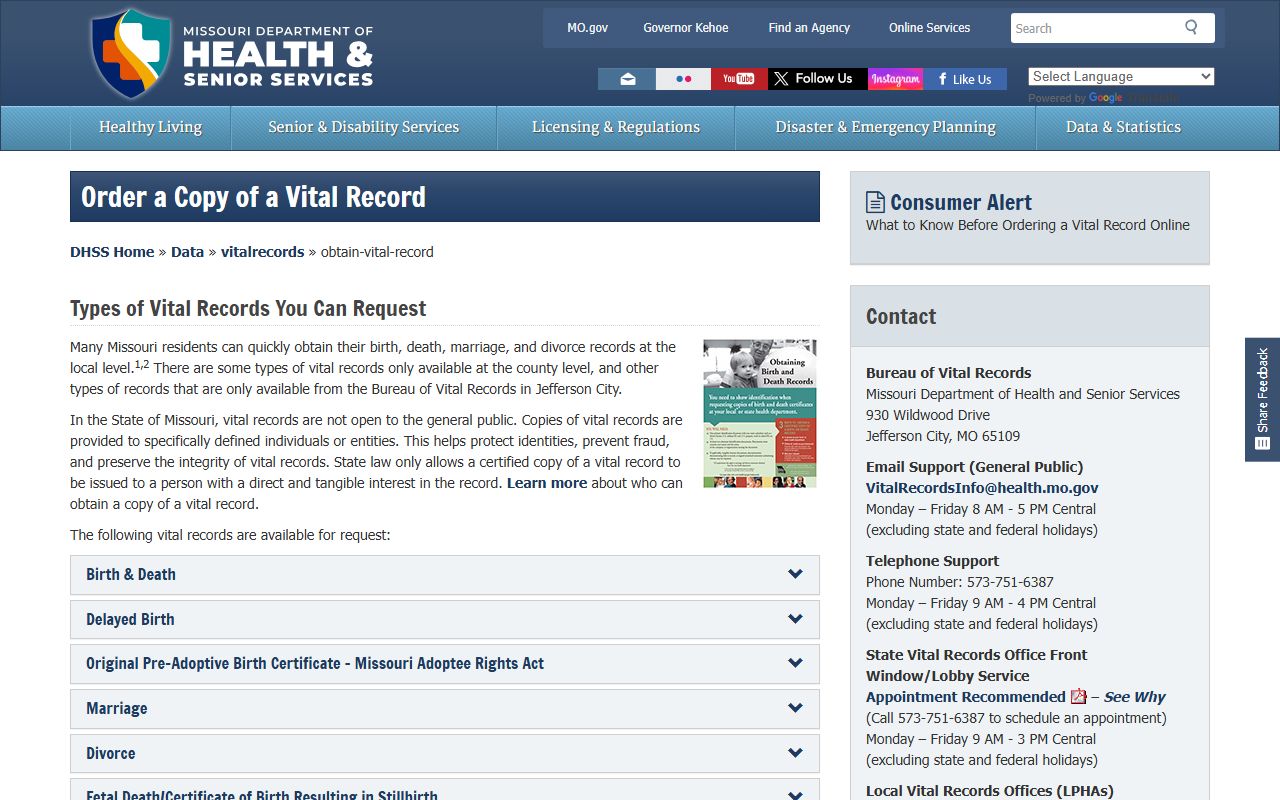
The screenshot below shows the state page for ordering vital records, including Missouri death certificates.
For online orders, use VitalChek. This is the state's authorized vendor for online and phone orders. Call 1-877-817-7363 or go to vitalchek.com. There is an extra service fee on top of the $14 state cost. Online orders usually arrive in 5 to 7 business days. Expedited shipping is also an option if you need it faster. VitalChek accepts credit and debit cards.
Who Can Get Death Records in Missouri
Missouri law sets rules for who can get a certified copy of a death certificate. Under RSMo 193.255 and state regulation 19 CSR 10-10.090, the list of eligible people is broader than for birth records.
Family members can request a copy. This includes spouses, parents, children, siblings, grandparents, and in-laws. Cousins, step-relatives, and other extended family are also eligible for death certificates. Funeral directors who are acting on behalf of the family can get copies. So can attorneys, physicians, and legal guardians with proper documentation. A person with a "direct and tangible interest" in the record may also apply. Genealogists who represent a family member or who are professionally recognized can request copies for research.
You will need to show at least one form of ID. A driver's license, military ID, passport, or work badge with a photo will work. If you don't have any of those, you can use two pieces of alternate identification like a utility bill and a Social Security card. Authorized agents must include a notarized statement from the eligible person.
Note: Death records over 50 years old are open to anyone at the Missouri State Archives without any eligibility requirement.
Search Historical Missouri Death Records
Missouri has a large collection of historical death records available for free online. The Missouri Death Certificate Database at the State Archives has digitized certificates from 1910 to 1975. You can search by first name, last name, county, year, and month. The site links to scanned images of the original certificates. This is a great tool for genealogy work and family history. There is no charge to view these records. Photocopies cost $1 each if you need a physical copy.
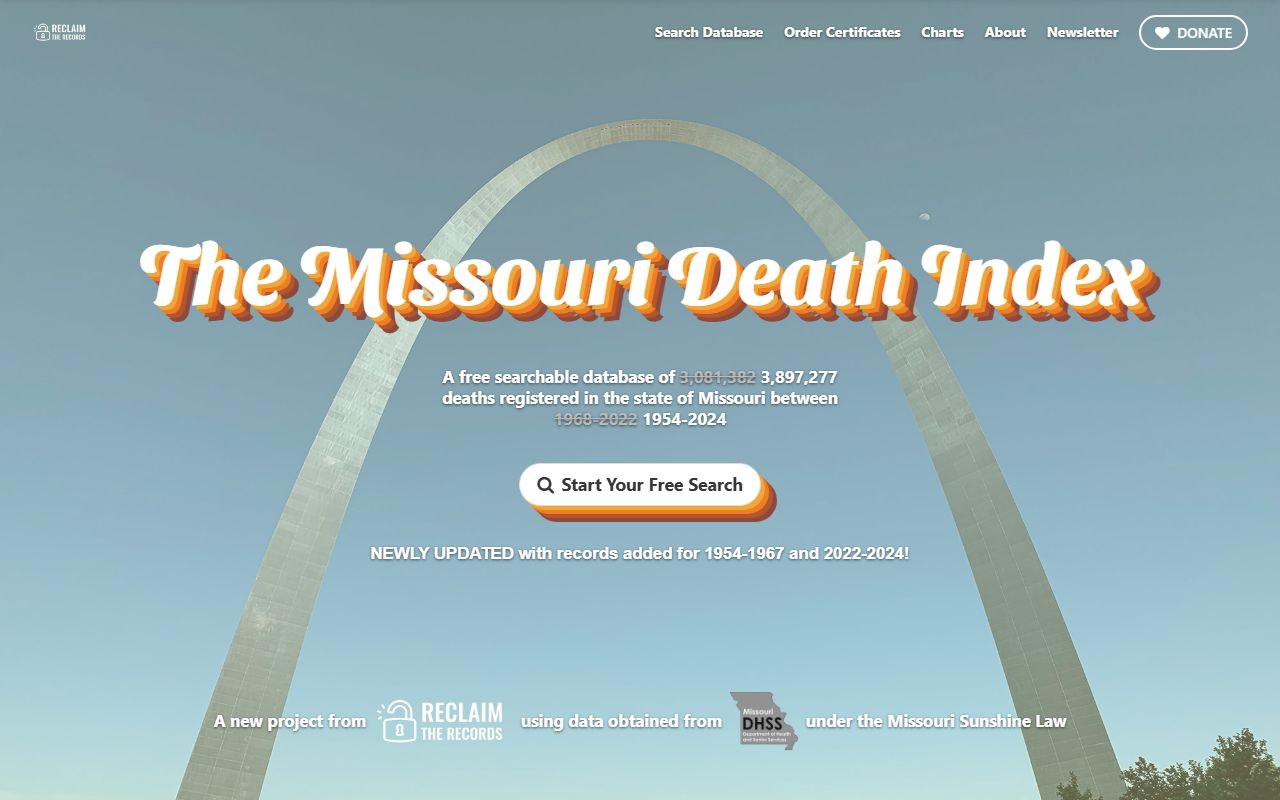
The Missouri Death Index is a free third-party site that covers deaths from 1968 to 2022. It lets you search by name and get basic details like the date and location of death. This can help you narrow down which county to contact for a full certificate.
Below is the Missouri Death Index search page, a free tool for finding Missouri death records from 1968 to 2022.
For records before 1910, check the Missouri State Archives pre-1910 index. Birth and death records from 1883 to 1893 exist in index form. These are incomplete because reporting was not required before 1910. Some county clerks also hold surviving records from this era. Coverage varies by county since many courthouses were lost to fires over the years.
What Missouri Death Certificates Show
A Missouri death certificate is a detailed document. It holds facts about the person who died and the circumstances of the death. Certified copies are used for settling estates, filing insurance claims, handling pensions, and closing accounts. Long-form certificates from the state Bureau have the most detail. Short-form abstracts from local health departments cover the basics and work for most purposes.
A death certificate in Missouri typically lists the full name of the person, date and place of death, date and place of birth, and parents' names including the mother's maiden name. It also shows the name of the surviving spouse, the person's occupation and residence, and the cause of death as certified by a physician or coroner. Funeral home information and burial or cremation details are included too. The informant's name appears on the certificate as well. Under RSMo 193.145, death certificates must be filed within 5 days of the date of death using the Missouri Electronic Vital Records system.
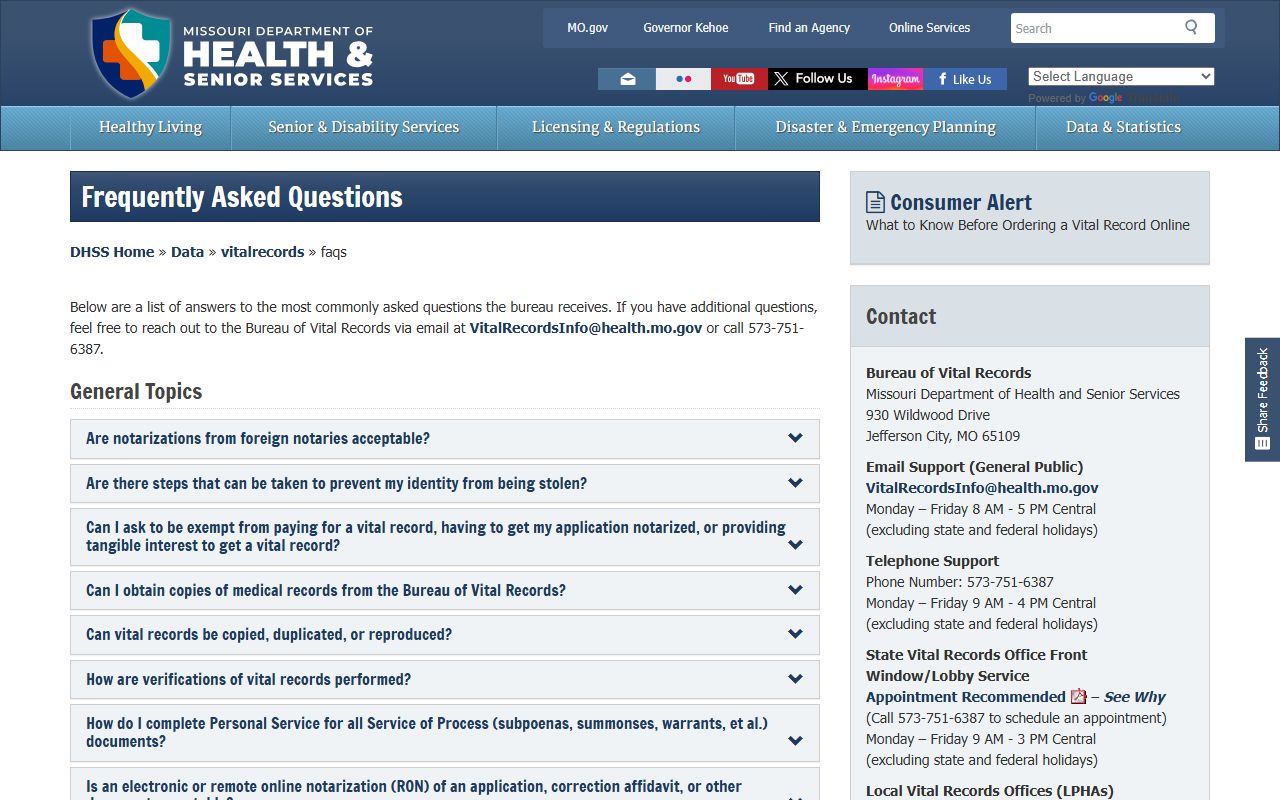
The FAQs page from the Bureau of Vital Records answers common questions about Missouri death certificates.
Missouri Death Record Fees
Fees are set by state law under RSMo 193.265. The standard cost is the same whether you order from the state or from a county health department.
A death certificate costs $14 for the first copy. Each additional copy ordered at the same time is $11. If you order through VitalChek, you pay the $14 state fee plus their service charge, which brings the total to around $24 or more depending on shipping. In-person requests at county offices are the cheapest since you avoid any extra fees. Mail requests to the state need a check or money order. Do not send cash through the mail.
Under RSMo 193.245, certified copies cannot be photocopied or reproduced for use by others. A photocopy of a certified death certificate is considered void. You need to order a new certified copy each time one is required for official use. Historical records at the State Archives cost $1 per photocopy and are for informational use only since certified copies cannot be issued for records that old.
Note: Some county offices do not accept out-of-state checks for payment, so call ahead to confirm accepted forms of payment.
Missouri Death Data and Special Records
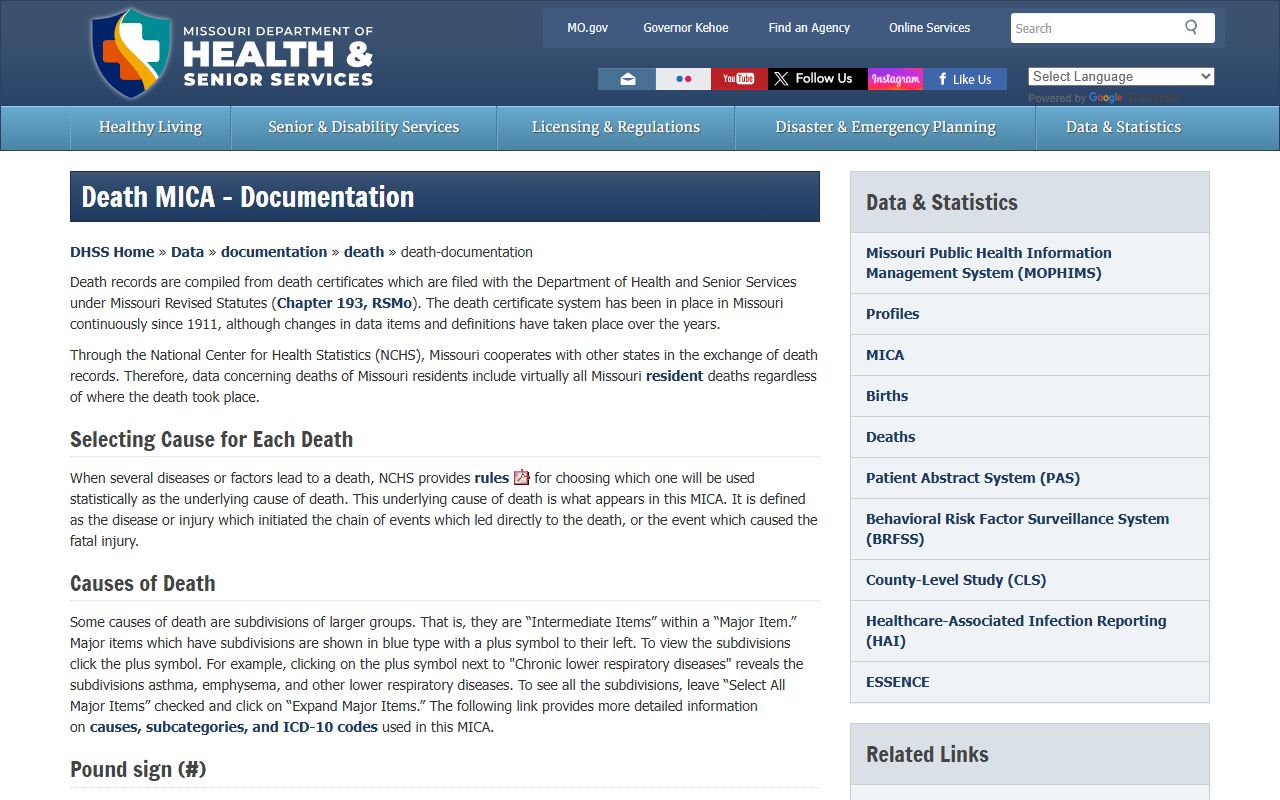
The Missouri Department of Health and Senior Services tracks death data for public health purposes. The death data documentation page explains how death statistics are collected and used in Missouri. This data helps with research on causes of death, public health trends, and population studies across the state.
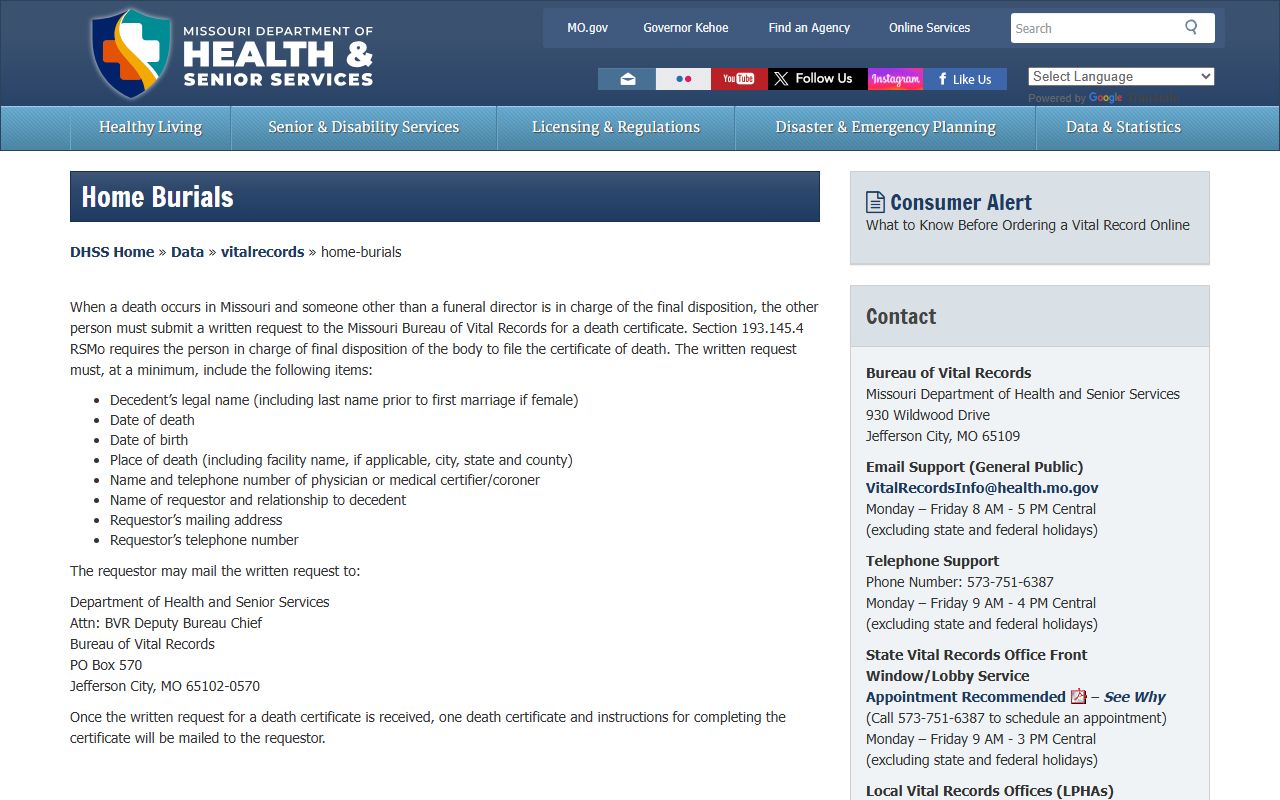
Missouri also has rules for home burials. If a family chooses to handle burial arrangements without a funeral home, specific steps must be followed. A death certificate still needs to be filed. The family takes on the duties that a funeral director would normally handle. The state provides guidance on this process through its vital records office.
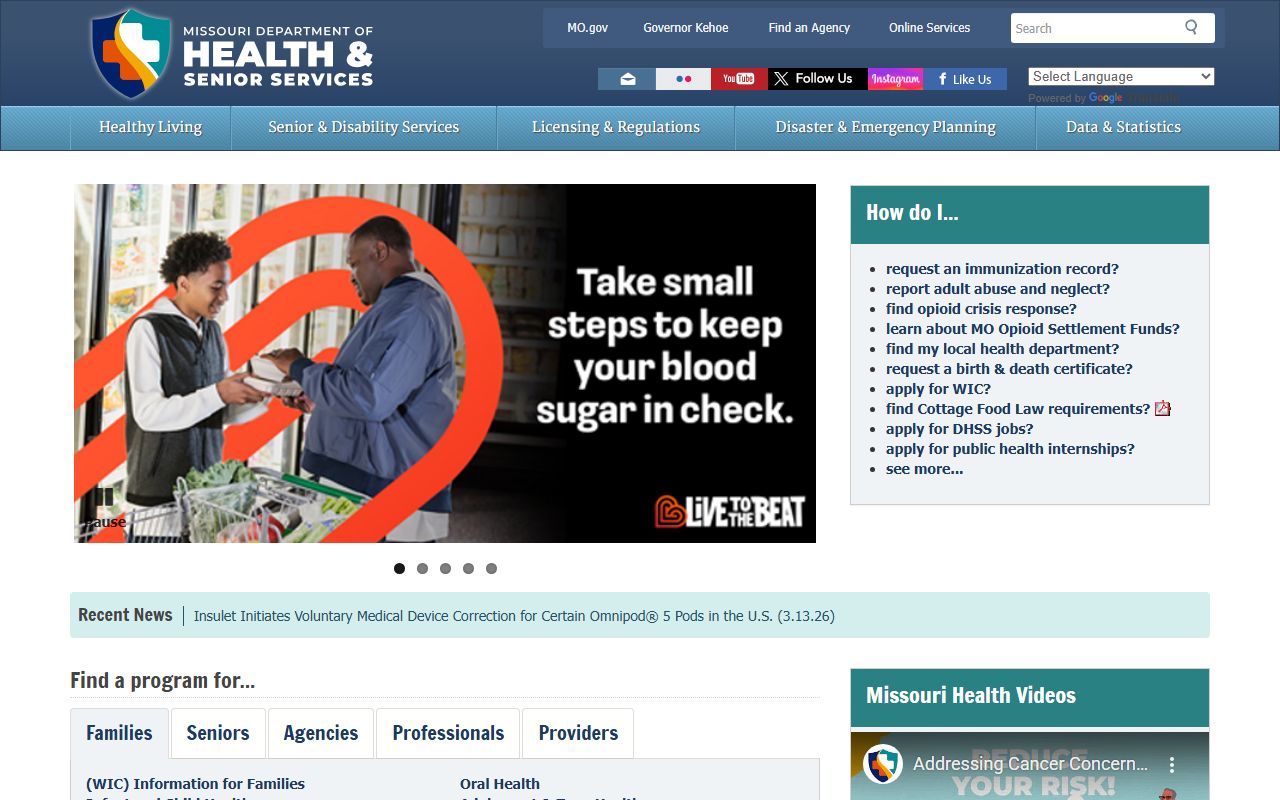
The Missouri Department of Health and Senior Services main site has additional resources for families dealing with a death in Missouri. From reporting requirements to planning guides, the department provides information to help navigate the process.
Browse Missouri Death Records by County
Each county in Missouri has a health department that can issue death certificates for deaths that happened in that area. Pick a county below to find local contact details, fees, and resources for death records.
Death Records in Major Missouri Cities
Residents of Missouri cities get death certificates through their county health department or, in some cases, a city health department. Pick a city below to find out where to get death records in your area.